Psychometric Network Model of Cognitive Ability
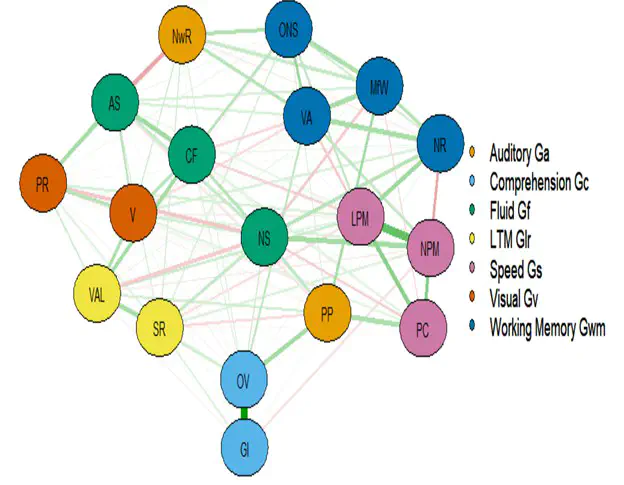 Snapshot of Psychometric Network Model (Woodcock-Johnson Tests of Cognitive Ability)
The positive manifold is one of the most replicated findings in the psychological sciences. The positive manifold refers to the finding of all positive correlations among a number of cognitive ability measurements, such that participants who score above average on one test (e.g., vocabulary) also score above average on other tests (e.g., mathematics). In the field of psychometrics, factor analysis is the primary statistical technique used to investigate the underlying structure of intelligence. Charles Spearman (1904) formulated the original factor model of general intelligence (g), which resulted in a single, explanatory factor of cognitive ability. This one-factor view of g was met with criticism, which led to the generation of many different factor models over the years.
A recent example is the Cattel-Horn-Carroll (CHC) model of intelligence. The CHC model initially saw the fractionation of g into a continuum of fluid (Gf) to crystallized (Gc) intelligence factors (Cattel, 1941; Horn, 1965) but later led to Carroll’s three-stratum hierarchical theory (1993). Thus, the CHC model consists of three differentiated levels: 1) observed measurements (e.g., vocabulary, mathematics) are located at the lowest-level; 2) broad cognitive abilities (e.g., short-term memory, crystalized intelligence) explain variation at the next level; and 3) g is located at the highest-level and explains the variation among mid-level cognitive ability factors. The CHC model provides a good fit to data yet after a century of research since the original formulation of Spearman’s g, the debate over exactly what g is and how g is structured continues (c.f., Kovacs & Conway, 2016; Protzko, 2017).
Recently, a number of articles have been published employing an alternative statistical technique to factor analysis called network modeling (cf., Epskamp & Fried, 2017; McNalley, 2006; van der Maas et al., 2017). In network models, partial correlation coefficients are calculated to establish the association between pairs of observed variables (referred to as nodes). It is typical for clusters of nodes that load together on a particular factor to be located more closely in these models than two variables that load on separate or orthogonal factors, although no factors are actually generated when utilizing network models, so there is no g (for an example, see Figure 4 of van der Maas et al., 2017). The primary advantage of network models is that instead of attempting to interpret subjective factors researchers can shift their focus to specific measurements and the one-to-one associations that exist between them (Guyon, Falissard, & Kop, 2017).
The primary objective of the current project was to develop a network model of intelligence based on data from the Woodcock-Johnson test published in Carroll (2003). From a philosophical perspective, we believe that network models avoid the intrinsic disadvantages associated with factor analysis because the nodes represent observed data instead of unobserved and difficult to interpret factors. Additionally, we argue that network models are superior to factor models when examining changes in intelligence, either as a function of developmental (in children and the elderly) or as a function of cognitive training (e.g., working memory training).

Christopher J. Schmank, PhD
Assistant Professor /Statistics Consultant
My research interests include the impact of psychosocial stress and emotional regulation on various cognitive abilities (i.e., processing speed, rationality, and language production). My additional skills include statistical modeling techniques using latent variable and/or psychometric network analyses. I am also experienced in user experience (UX) strategy and research including A/B testing, rapid prototyping, and competitive analyses.